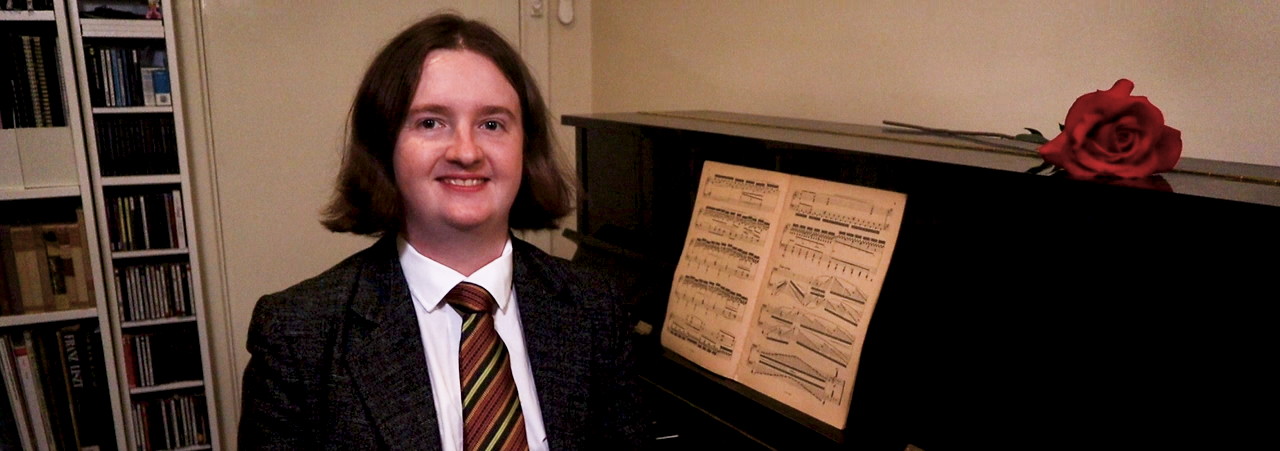
Check Out My New YouTube Video!
I've been planning on getting my YouTube channel up and running for some time now... and it's finally happened!
Too often, I think, classical music is presented without any explanation. People get up on stage, play their piece, and walk off again... To me this is a shame because the stories behind the music, the historical context, the personalities of composers and performers, are always just as interesting as the music itself, and some explanation can also help to make the music more accessible to those who aren't already in the know. If you've ever been to one of my recitals, you know I always like to preface my performances with a little bit of talking. I wanted to make a YouTube channel centred around this idea, talking and playing, sharing my passion for nineteenth century music.
My first video is about one of the most fascinating figures in music history, the great Polish pianist Ignacy Jan Paderewski (1860-1941), who also became the first prime minister of the Polish republic after it was founded in 1919. Paderewski is to me the quintessential figure of the "golden age of the piano", and a personal hero for me. I admire not only his playing and compositions, but the grit and determination he showed in pursuing his goals.
Paderewski had a difficult upbringing, and a long and arduous journey to fame as a pianist. By the mid-1890s, he was at the top of the business, and certainly the most famous pianist in the world. Researching the life of Arthur Friedheim (1859-1932), for my PhD, gave me an appreciation for just how famous and beloved Paderewski was. Friedheim was in a sense a direct competitor to Paderewski, almost exact contemporaries, both debuting in America in 1891, and building their respective careers alongside one another. While Friedheim was probably a better pianist, technically speaking, he consistently struggled to reach the emotions of his listeners. Paderewski, however, was a master of swaying hearts, and the resultant outlines of their careers demonstrates the value of that kind of personal magnetism as a pianist. Paderewski constantly played to packed out houses in America, was constantly talked about in the press, and became a true cultural icon of the time. Friedheim spent his career, it seems to me, chasing the kind of popular esteem that Paderewski won immediately during his first American tour in 1891. Friedheim never quite attained it, until his Canadian tours in 1912 and 1913. Even then, he was stopped short by the wheels of fate: the outbreak of the great war.
In contrast to Friedheim, Paderewski's importance to history is not just as a musician, but as a statesman who helped bring to life an independent Polish republic following the war. I think it is incredible the strength of character showed by Paderewski in pursuing this mission, taking it upon himself to stand up and speak on behalf of his country.
I've often enjoyed playing Paderewski's compositions at home, and have performed a few of them publically in the last couple of years. My favourite works have been his Melodie (from Chant du Voyageur), Nocturne and Krakovienne Fantastique, which are beautiful and emotional works, very well written for the piano. Undoubtedly his most famous work is his Minuet in G, a dainty and unassuming little work that has been recorded by several of my favourite pianists of the past including Alfred Grünfeld, Sergei Rachmaninoff and of course Paderewski himself.
Paderewski's Minuet was so famous that, according to the music critic Henry E. Krehbiel in the mid-1890s, it was known "wherever the pianoforte is played". Paderewski himself notes in his memoir that the work was so popular that his fame as a pianist was almost built on the foundation laid by the Minuet. In a sense, then, this little Minuet is responsible for the Paderewski's rise in the world, that resulted in the foundation of an independent Poland. Isn't it funny to think that the history of a country, and one might say, all of subsequent European history, could have been shaped by such a dainty little piano piece? Can music really change the world?
In my new YouTube video, I talk about Paderewski's life as a musician and statesman, a little about his playing, and then conclude with my own performance of his Minuet in G.